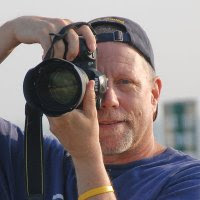
Final part of multi-part post about a short photo trek I took, with my brother Tom, in northern California in mid-March (2008).
After striking out on any early morning shots of Mount Shasta, we headed south on I-5 and took highway 89 planning to hit the north side of Lassen Volcanic National Park. Highway 89 is a Scenic Byway and I was hoping to find some good photo opportunities along its path. One good photo opportunity presented itself in the small town of McCloud. We found some nice views of Mount Shasta from besides the train maintenance yard in McCloud. Again, the mountain did not want to cooperate the peak was shrouded in white clouds. This location should be a nice position for either sunrise or sunset as you are looking pretty much due north at the mountain. The train yard would also provide some different foreground subjects for the mountain. Traveling west on highway 89, we found a small scenic vista that would also provide some nice views of Mount Shasta. This spot should yield some good views of the peak framed by dark green pine trees and looked like the most promising spot we'd found.
We continued on highway 89 deciding to take a stop at Burney Falls State Park. Our grandparents, residents of San Francisco, often spent the summers near Burney in their travel trailer, but neither of us had actually visited the falls. Wow, the falls are impressive with a flow rate of a 100 million gallons of water per day! And, the rate doesn't slow during the dry summers as they are spring fed. We spent some time photographing the falls - beware that the mist is a problem if you close to the falls - but I didn't get anything spectacular as we were they mid-day and the white sky was blowing out on all my images. The falls are a definite on my "re-visit" list!
Highway 89 loops down to the south and touches the northwest corner of Lassen Volcanic National Park at Summertown and Manzanita Lake. At this point, highway 89 continues through the park, but it was closed (as it is every winter) due to snow in the park. Highway 44 continues west toward Shingletown and from there we took Manton Road thru the town on Manton and eventually to highway 36 which leads into Red Bluff. There are some very pretty sections of road with steep changes in elevation on Manton Rd as you descend in the flat, central valley region. Once back to Red Bluff it is high speed highways 99, 70, and 65 back to greater Sacramento area.
Monday, March 31, 2008


Friday, March 28, 2008
Northern California early Spring photography - Part 3
Read my previous couple of posts about northern California photography to get the details before this event.
After Gray Lodge, my brother and I decided we wanted to try and get some sunrise shots of Mount Shasta. We figured that with clear evening skys and lots of snow in the higher elevations this year it might be a good chance to get some "golden light" on the mountain at first light. It is about a 2.5 hour drive from Gray Lodge to Mount Shasta via highway 99 (Chico, Los Molinos, and Red Bluff) and I-5 (Redding, Lake Shasta, Dunsmir) to Weed. We didn't get away from Gray Lodge until dark and a bright moon kept teasing us with nice clear views of Mt. Shasta once we got close. We found a cheap motel (Motel 6) in Weed and set our alarms for 5:00a even though official sunrise wasn't until 7:15a PDT. That's one nice benefit of the earlier switch to daylight savings time and a good reason to like winter photography - the sun rises a bit later than the middle of summer so you're not operating on 3-4 hours of sleep every day.
We woke up to very low clouds on Monday morning and cursed the weather. We decided to drive north on I-5 in hopes to get a view of a clearing mountain as we gained some elevation. None of that was going to happen as we drove I-5 and took the West Louie Road exit that leads to Gazelle. A quick gaunt thru Gazelle (can't be more than 40 or 50 residents) and we started heading back south on Old Hwy 99. No particular outstanding photo opportunities presented themselves though we stopped at one point and photographed a nice small volcanic cinder cone with a crown of clouds in the VERY gray light.
Mount Shasta seems to be a good photo subject with decent light and should be good for either sunrise or sunset. However, we did find some better spots on highway 89 (Volcanic Legacy Scenic Byway) that should prove more worthwhile than going all the way to Weed. I'll cover the highway 89 opportunities in another posting.
After Gray Lodge, my brother and I decided we wanted to try and get some sunrise shots of Mount Shasta. We figured that with clear evening skys and lots of snow in the higher elevations this year it might be a good chance to get some "golden light" on the mountain at first light. It is about a 2.5 hour drive from Gray Lodge to Mount Shasta via highway 99 (Chico, Los Molinos, and Red Bluff) and I-5 (Redding, Lake Shasta, Dunsmir) to Weed. We didn't get away from Gray Lodge until dark and a bright moon kept teasing us with nice clear views of Mt. Shasta once we got close. We found a cheap motel (Motel 6) in Weed and set our alarms for 5:00a even though official sunrise wasn't until 7:15a PDT. That's one nice benefit of the earlier switch to daylight savings time and a good reason to like winter photography - the sun rises a bit later than the middle of summer so you're not operating on 3-4 hours of sleep every day.
We woke up to very low clouds on Monday morning and cursed the weather. We decided to drive north on I-5 in hopes to get a view of a clearing mountain as we gained some elevation. None of that was going to happen as we drove I-5 and took the West Louie Road exit that leads to Gazelle. A quick gaunt thru Gazelle (can't be more than 40 or 50 residents) and we started heading back south on Old Hwy 99. No particular outstanding photo opportunities presented themselves though we stopped at one point and photographed a nice small volcanic cinder cone with a crown of clouds in the VERY gray light.
Mount Shasta seems to be a good photo subject with decent light and should be good for either sunrise or sunset. However, we did find some better spots on highway 89 (Volcanic Legacy Scenic Byway) that should prove more worthwhile than going all the way to Weed. I'll cover the highway 89 opportunities in another posting.
Thursday, March 27, 2008
More on northern California photography
Spent a late afternoon at Gray Lodge wildlife refuge hoping to get some good closeups of waterfowl. This is an 8400 acres of wetland about 8 miles southeast of Gridley, California and approximately 60 miles north of Sacramento. The refuge enjoys the Sutter Buttes (worlds shortest mountain range) as a backdrop. I thought we'd be in luck as there was a white heron standing about 20 feet off the road when we turned onto the access road, but that was about as close as we'd get to any birds. We drove the auto loop and there were a good number of ducks, and tried walking down a side access path trying to sneak up on a heron and other water fowl. I was shooting with a 100mm-400mm zoom with 1.4 teleconverter and wished for more! The fading light soon proved that the f4.5 - 5.6 lens (with the loss of 1 additional stop due to tele-converter) wasn't going to work out. In the 90 minutes we spent stalking some birds we did witness some close fly bys of a heron, buzzard, owl, pheasant, and other fowl. I did get a couple of decent shots of the golden light during sunset, but was still pretty disappointed at my overall lack of any decent images.
Doing some more research on the web indicates that the best time to go to Gray Lodge is December - January during the peak migratory time. It was a pleasure to be there without a ton of other people and next time I'll want to check out the blind structures that I've read about that might provide a better (and warmer) place to photograph from. For more info on Gray Lodge check out http://www.dfg.ca.gov/lands/wa/region2/graylodge/index.html
Doing some more research on the web indicates that the best time to go to Gray Lodge is December - January during the peak migratory time. It was a pleasure to be there without a ton of other people and next time I'll want to check out the blind structures that I've read about that might provide a better (and warmer) place to photograph from. For more info on Gray Lodge check out http://www.dfg.ca.gov/lands/wa/region2/graylodge/index.html
Tuesday, March 25, 2008
Early Spring in northern California
I went to California on March 13th to help my brother, Tom, shoot an event. I spent a few extra days visiting my brother and sister and found some interesting photography opportunities. Hidden Falls Regional Park is a new park (formerly Didion Ranch land) between Auburn and Lincoln (Mt Vernon Road) in Placer County. The park includes 6+ miles of hiking trails. The Blue Dicks and Shooting Star wild flowers were in bloom and there is a couple of small falls to photograph along Coon Creek. The main falls, at the convergence of Coon & Deadman Creek are not accessible to photograph, but they are building a platform that will allow you to get closer to the falls. I applaud the Placer County Open Space & Conservation project that has allowed land such as this to be spared from the rampant developers that have drastically changes much of the California landscape of the past couple of decades. Here's a link to more info on Hidden Falls Regional Park: http://www.placer.ca.gov/Departments/Facility/Parks/hiddenfalls.aspx.
Monday, March 24, 2008
A way to fix sky in Photoshop
I've been away for a few days (weeks). Sorry... I'll try my best to catch up over the next several days.
I ran across this article in the latest (April 2008) issue of Popular Photography magazine and gave it a quick try with an image from a Colorado trip a couple of years back. It's a nice approach to subtly fixing over exposed sky in an image. I've always hated the "fringe" you get when trying to alter a sky in Photoshop. I like the way I can go back and alter the layer mask to change the adjustment. Seems like I'm always looking at images I've edited previously and wondered why I edited them the way I did. Anyway, here's the link: http://www.popphoto.com/popularphotographyfeatures/5168/how-to-fix-the-sky.html
By the way, it worked for me in CS2 as written.
I ran across this article in the latest (April 2008) issue of Popular Photography magazine and gave it a quick try with an image from a Colorado trip a couple of years back. It's a nice approach to subtly fixing over exposed sky in an image. I've always hated the "fringe" you get when trying to alter a sky in Photoshop. I like the way I can go back and alter the layer mask to change the adjustment. Seems like I'm always looking at images I've edited previously and wondered why I edited them the way I did. Anyway, here's the link: http://www.popphoto.com/popularphotographyfeatures/5168/how-to-fix-the-sky.html
By the way, it worked for me in CS2 as written.
Subscribe to:
Posts (Atom)